
Quartzite vs Marble: What Las Vegas Homeowners Need to Know
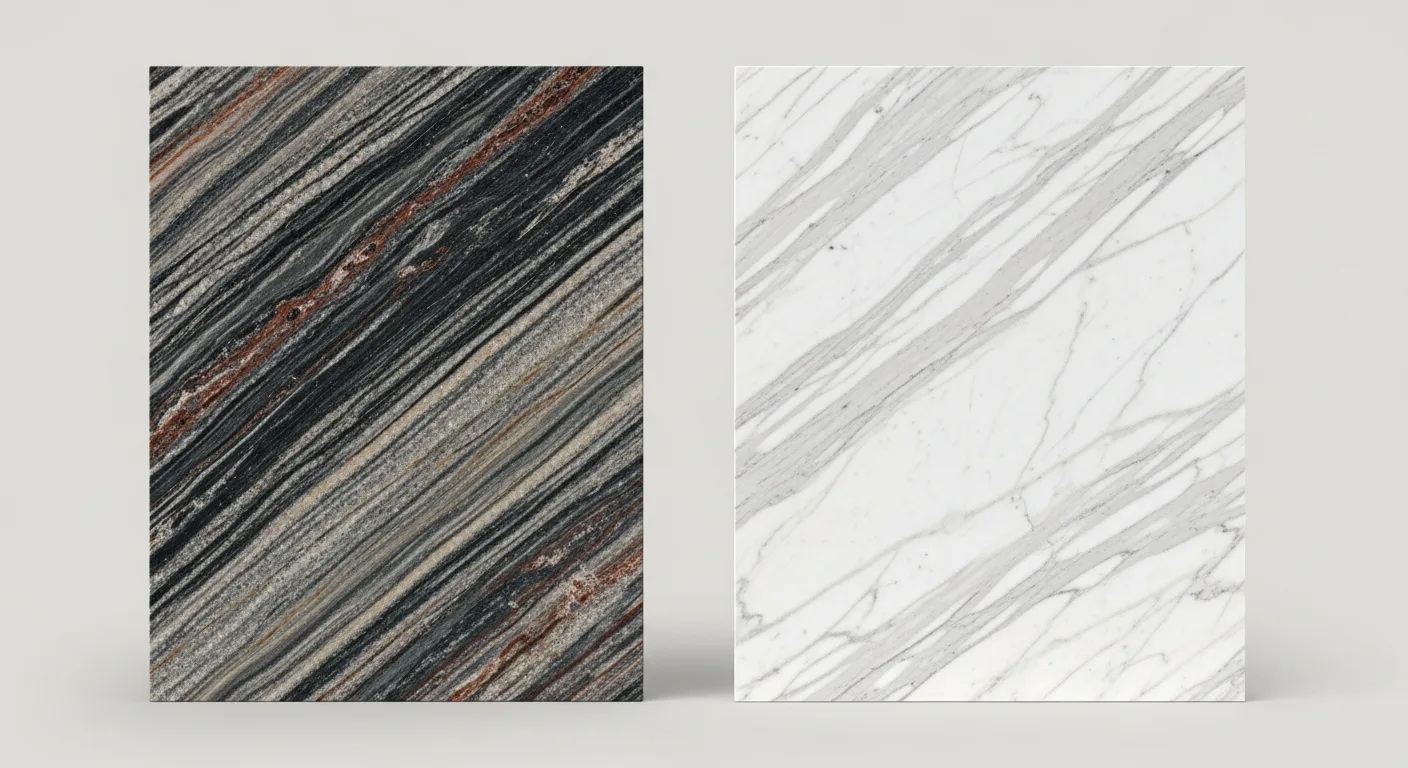
Image is illustrative.
Quartzite and Marble are the two most stunning natural stones we fabricate. They both feature dramatic veining and elegant movement that no engineered material can replicate. But they perform very differently in your home, and understanding those differences saves you from an expensive mistake.
Here is the direct answer: Quartzite gives you the luxurious veined look of Marble with the durability of Granite. If you love the Marble aesthetic but need a surface that can handle daily kitchen use and Las Vegas hard water without constant worry, Quartzite is the stronger choice. If you want the timeless warmth and softness that only true Marble provides and you are willing to invest in its care, Marble remains unmatched.
We have fabricated and installed both materials across Las Vegas, Henderson, and Summerlin for over 20 years. This guide is the honest comparison we share with every homeowner who falls in love with veined natural stone at our slab yard.
Key Takeaways
- Quartzite is nearly twice as hard as Marble (7 Mohs vs 3-4 Mohs), making it far more resistant to scratches and etching
- Both stones require sealing, but Marble needs resealing every 6-12 months while Quartzite needs it every 1-2 years
- Quartzite handles Las Vegas hard water at 278 ppm significantly better than Marble
- Both are natural stones with genuine veining, but Marble has warmer tones while Quartzite leans cooler and more crystalline
- Cost ranges overlap: Quartzite runs $60-$150/sqft installed, Marble runs $50-$150/sqft installed
Side-by-Side Comparison
| Feature | Quartzite | Marble |
|---|---|---|
| Hardness | 7 Mohs (very hard) | 3-4 Mohs (soft) |
| Heat Resistance | Excellent | Good |
| Stain Resistance | Good when sealed | Fair, requires vigilant sealing |
| Scratch Resistance | Excellent | Poor, scratches easily |
| Acid Sensitivity | Low | High, etches from citrus and wine |
| Maintenance | Seal every 1-2 years | Seal every 6-12 months |
| UV Resistance | Excellent | Excellent |
| Appearance | Cool-toned veining, crystalline depth | Warm-toned veining, classic elegance |
| Cost Range (Installed) | $60 - $150/sqft | $50 - $150/sqft |
| Best For | Kitchens, heavy-use surfaces, marble-look with durability | Bathrooms, low-use areas, formal spaces |
Durability: Where Quartzite Dominates
This is the single biggest difference between these two stones, and it is not close.
Quartzite scores 7 on the Mohs hardness scale, making it as hard as Granite. It forms when sandstone undergoes extreme heat and pressure deep in the earth, fusing quartz grains into an incredibly dense crystalline structure. You can chop, slide pots, and set heavy appliances on Quartzite without worry.
Marble scores 3-4 on the Mohs scale. It is a metamorphic limestone, beautiful but fundamentally soft. A kitchen knife can scratch Marble. A dropped cast iron pan can chip it. Acidic foods like lemon juice, tomato sauce, and red wine will etch the surface on contact, leaving dull marks that require professional honing to remove.
We installed Taj Mahal Quartzite in a Summerlin family's kitchen three years ago. They have four kids, cook every night, and treat the countertops like a workhorse surface. When we visited for an unrelated backsplash project last month, those countertops still looked like day one. That kind of resilience simply is not possible with Marble in a high-use kitchen.
Winner: Quartzite. If your countertops will see daily cooking, kids, and real life, Quartzite handles it all without flinching.
Maintenance: Two Different Commitments
Both Quartzite and Marble are porous natural stones that require sealing. But the maintenance schedules differ significantly.
Quartzite needs sealing every one to two years. Between sealings, it resists stains from most household spills. Its density means liquids sit on the surface longer before any penetration occurs, giving you time to wipe up messes without panic.
Marble needs sealing every six to twelve months. Even when properly sealed, Marble remains vulnerable to etching from acidic substances. This is not a stain issue; it is a chemical reaction between acids and the calcium carbonate in the stone. Sealing protects against stains but does not prevent etching.
Daily care differs too. With Quartzite, soap and water handles everything. With Marble, you need pH-neutral cleaners only. Standard kitchen cleaners, vinegar-based solutions, and even some "natural" cleaning products contain acids that will etch an unsealed or poorly sealed Marble surface.
Winner: Quartzite. Not because Marble is impossible to maintain, but because Quartzite forgives mistakes. If you forget to wipe up a lemon slice or spill red wine during a dinner party, Quartzite gives you grace that Marble does not.
Appearance: Both Beautiful, Different Character
This is where the decision gets personal, because both stones are genuinely breathtaking.
Quartzite features bold, sweeping veins with a crystalline depth that seems to glow from within. The veining tends toward cooler tones: whites, silvers, soft golds, and pale blues. When light hits a polished Quartzite slab, you see a translucent quality that is unique to this stone. The patterns are dramatic, often with strong linear movement that draws the eye across the full slab.
Marble features softer, warmer veining with a depth that feels almost like looking into the stone itself. Classic Marble veining ranges from subtle gray wisps in Carrara to bold golden rivers in Calacatta. Marble has a warmth and softness in both appearance and touch that has made it the material of sculptors, architects, and designers for thousands of years.
Here is one key difference we point out at our slab yard: Marble develops a patina over time. That gentle aging gives it character and depth that many homeowners actually love. Quartzite stays looking exactly as it did on installation day. Whether that aging is a pro or a con depends entirely on your perspective.
No winner here. Both are stunning. Your preference for cool crystalline drama versus warm classic elegance will guide this choice.
Ready to compare them in person? Visit our slab yard and see full Quartzite and Marble slabs side by side. Call (702) 809-8436 to schedule a visit, or request a free estimate.
Cost Comparison
The price ranges for Quartzite and Marble overlap heavily, though entry-level Marble starts slightly lower.
| Material | Cost Per Sq Ft (Installed) | 30 Sq Ft Kitchen | 50 Sq Ft Kitchen |
|---|---|---|---|
| Quartzite | $60 - $150 | $1,800 - $4,500 | $3,000 - $7,500 |
| Marble | $50 - $150 | $1,500 - $4,500 | $2,500 - $7,500 |
Basic Carrara Marble starts around $50 per square foot installed, making it the more affordable entry point. But premium Calacatta Marble quickly reaches $120 to $150 per square foot. Quartzite starts slightly higher at $60, with exotic varieties like Taj Mahal and Cristallo reaching similar premium price points.
These prices include digital templating, CNC fabrication, a standard edge profile, installation, and initial sealing. Sink cutouts ($150-$300), upgraded edge profiles ($10-$30 per linear foot), and old countertop removal ($200-$500) are quoted separately.
Consider lifetime cost too. Marble's more frequent sealing schedule and potential need for professional honing or polishing add ongoing costs that Quartzite largely avoids. Over a 15-year span, Marble maintenance costs can add $1,500 to $3,000 depending on use and care habits.
Bottom line: Upfront, they cost about the same. Long-term, Quartzite is the more economical choice due to lower maintenance demands.
Las Vegas Performance
Las Vegas is not a typical city for countertop materials. Our desert climate creates specific challenges that affect Quartzite and Marble differently.
Hard Water (278 ppm)
This is where Quartzite pulls significantly ahead. Las Vegas hard water at 278 ppm leaves mineral deposits on any natural stone surface. On Quartzite, those deposits sit on top and wipe away with routine cleaning. On Marble, hard water minerals interact with the softer stone surface and can create buildup that requires more aggressive removal, especially around sink areas.
We see Marble countertops around kitchen sinks in Las Vegas develop a cloudy mineral film within months if not maintained vigilantly. Quartzite handles the same water exposure with no visible effects between routine cleanings.
UV Exposure
Both Quartzite and Marble are completely UV-safe. Unlike engineered Quartz, these natural stones will never yellow or degrade from desert sun exposure through west-facing windows. This is a genuine advantage of both natural stones in sun-drenched Las Vegas homes.
Sealing in Desert Conditions
Las Vegas dry air actually helps both stones in one way: spills evaporate faster, giving you more time before liquids penetrate. But the combination of hard water and alkaline dust means sealing schedules matter more here than in humid climates. Quartzite's 1-2 year sealing cycle is manageable. Marble's 6-12 month cycle demands more attention.
Heat Resistance
Both stones handle Las Vegas summer heat coming through windows or radiating from nearby outdoor kitchens. Neither will crack or discolor from ambient heat. For direct contact with hot pans, Quartzite is more forgiving, though we recommend trivets for both materials to preserve their polished finish.
Choose Quartzite If...
- You love the veined Marble look but need a kitchen workhorse surface
- You cook frequently and want a surface that forgives hot pans and knife contact
- Las Vegas hard water concerns you and you want lower-maintenance natural stone
- You prefer a surface that stays looking brand-new for years without developing patina
- You want to seal once every 1-2 years instead of twice a year
- Your countertops are in a high-traffic kitchen with kids or heavy entertaining
Choose Marble If...
- You value the timeless, classic warmth that only genuine Marble provides
- Your countertops are in a low-traffic bathroom, butler's pantry, or formal bar
- You appreciate the patina and character that develops with use over time
- You are committed to regular maintenance and careful daily use
- You want the lowest possible entry price for premium veined natural stone
- Design authenticity matters more to you than convenience
Can You Use Both? The Smart Combination
This is actually our most common recommendation for homeowners torn between these two stones. Use each material where it performs best.
Quartzite in the kitchen. Your kitchen countertops take the most abuse: hot pans, acidic foods, hard water from the sink, constant chopping and prep. Quartzite handles all of it without worry.
Marble in the bathroom. Your bathroom countertops see lighter use: no acidic foods, less heat exposure, and primarily cosmetic products. Marble's warmth and elegance shine in a space where its softness is not a liability. A Marble vanity in a master bathroom creates a spa-like atmosphere that Quartzite, despite its beauty, cannot quite replicate.
Maria and David built their dream home in Henderson last year. She wanted Marble everywhere. He worried about maintaining it in the kitchen with three teenagers. We suggested Taj Mahal Quartzite for the kitchen island and perimeter, then Calacatta Marble for the master bathroom vanity and the powder room. Both got the veined natural stone look they loved, each material placed where it would thrive. A year later, the kitchen still looks pristine through daily heavy use, and the bathrooms have the warm elegance Maria envisioned.
Popular Varieties Compared
Taj Mahal Quartzite vs Calacatta Marble
Taj Mahal Quartzite is the most requested Quartzite we fabricate. Its soft gold and cream veining on a warm white background draws constant comparisons to Calacatta Marble. The difference? Taj Mahal will handle your kitchen for decades without etching or damage. Calacatta will develop character marks from day one in a working kitchen.
If you love the warm gold veining of Calacatta but want kitchen-proof durability, Taj Mahal Quartzite is its closest match. Visit our slab yard and we will show them side by side.
Super White Quartzite vs Carrara Marble
Super White Quartzite offers cool gray-on-white veining that closely mirrors classic Carrara Marble. Both feature subtle, elegant movement rather than dramatic bold veining. But Super White scores a 7 on the Mohs scale while Carrara scores a 3. For homeowners wanting the understated elegance of Carrara in a kitchen setting, Super White Quartzite delivers the look with none of the vulnerability.
One note: true Super White Quartzite exists alongside a look-alike Dolomite that is sometimes sold under the same name. Dolomite is softer (5-5.5 Mohs) and behaves more like Marble. We verify every slab in our yard to ensure you get genuine Quartzite hardness when that is what you are paying for.
Frequently Asked Questions
Is Quartzite more expensive than Marble?
Not significantly. Quartzite starts slightly higher at $60 per square foot installed compared to $50 for entry-level Marble. At mid-range and premium tiers, prices overlap completely. However, Quartzite costs less to maintain over its lifetime due to less frequent sealing and fewer repair needs.
Does Quartzite etch like Marble?
No. Quartzite's composition (fused quartz grains) does not react with acids the way Marble's calcium carbonate does. You can use lemon, vinegar, and acidic foods on Quartzite without fear of etching. This single property is why many homeowners choose Quartzite over Marble for kitchens.
Can Marble work in a kitchen?
Yes, but with caveats. Marble requires more attentive care in a kitchen: immediate cleanup of acidic spills, consistent sealing every 6-12 months, and acceptance that the surface will develop patina over time. Many homeowners love their Marble kitchens. It works best for people who view the maintenance as part of the experience rather than a burden.
Which handles Las Vegas hard water better?
Quartzite handles hard water significantly better. Its denser, harder surface resists mineral buildup and cleans easily with routine wiping. Marble's softer surface allows hard water minerals to interact with the stone more aggressively, requiring more frequent deep cleaning around sink areas.
Do both materials need sealing?
Yes. Both are porous natural stones. Quartzite needs sealing every 1-2 years. Marble needs sealing every 6-12 months. We seal both at installation and our sister company, Night and Day Stone Restoration, handles resealing for homeowners who prefer professional maintenance.
Which is better for resale value?
Both add premium value to a Las Vegas home. Quartzite in the kitchen signals durability and smart material selection to buyers. Marble in bathrooms signals luxury and design sophistication. A home with both, used in the right rooms, often commands the highest perceived value.
See Both Stones at Our Slab Yard
The photos online never do these materials justice. Quartzite's crystalline depth and Marble's warm translucence both need to be seen in person and under natural light. Visit our slab yard and we will walk you through full slabs of both materials, explain which varieties match your design vision, and help you decide where each belongs in your home.
We are a family-owned fabrication shop with 20+ years of stone expertise in the Las Vegas valley. Whether you choose Quartzite countertops, Marble countertops, or a combination of both for different rooms, we handle every step from slab selection to installation.
Call (702) 809-8436 to schedule your slab yard visit, or request a free estimate online. We are available 7 days a week, 7 AM to 8 PM. No pressure, no hidden fees, just honest guidance from people who work with natural stone every day.
Ready to Get Started?
Call us for a free estimate. Visit our slab yard and hand-pick your exact stone.