
Waterfall Countertop Islands: Design Ideas and What They Cost
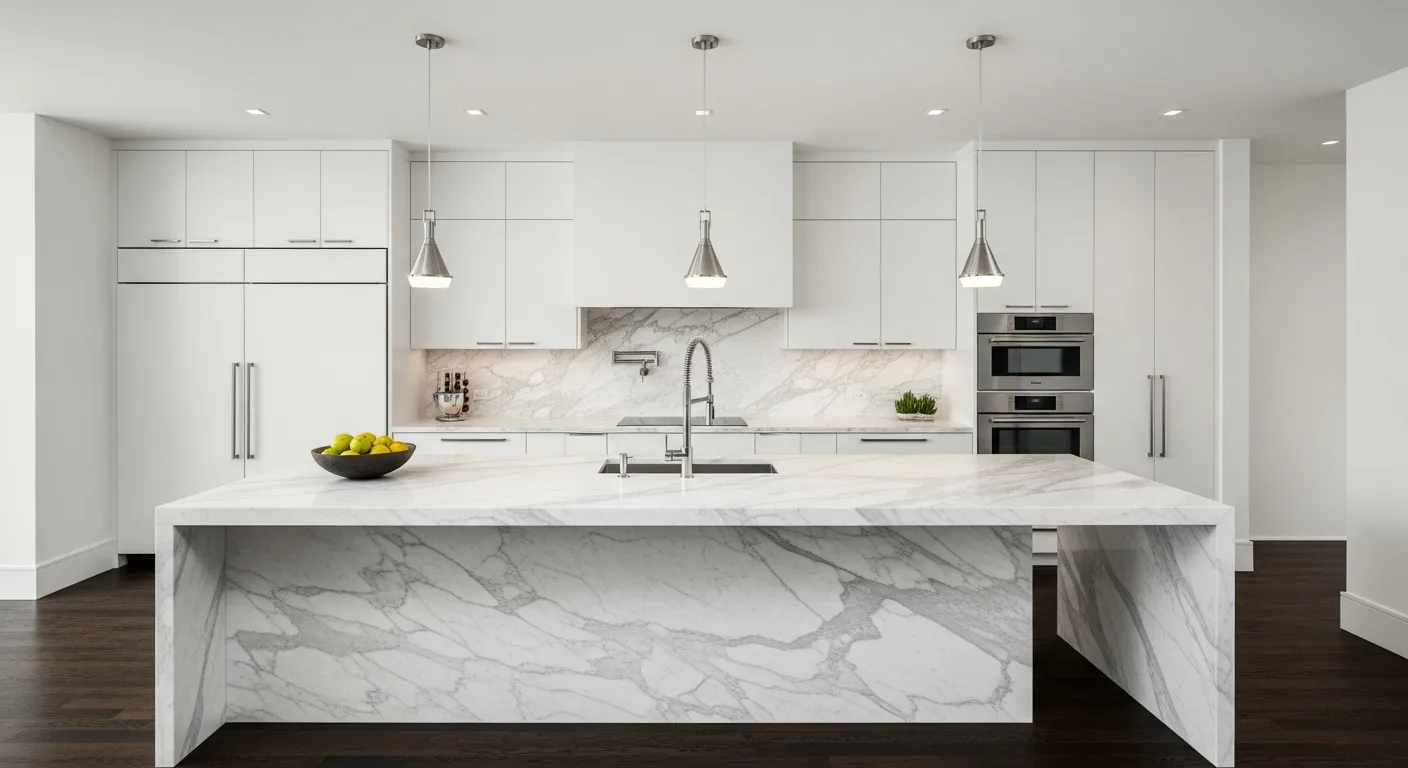
Image is illustrative.
A waterfall countertop island is one of the most striking features you can add to a kitchen. Instead of ending at the edge, the countertop material flows straight down one or both sides of the island to the floor, creating a continuous panel of stone. It is a bold, clean design statement that turns your island into the centerpiece of the room. Adding a waterfall edge typically costs $1,500 to $5,000 or more on top of a standard island project, depending on the material, the number of waterfall sides, and the complexity of vein matching.
At Night & Day Stone, we fabricate waterfall countertop islands for homeowners across Las Vegas, Henderson, and Summerlin. This is one of our favorite features to build because it demands precise craftsmanship and the result is always stunning.
Key Takeaways
- A waterfall countertop island costs an additional $1,500 to $5,000+ beyond a standard island, depending on the material and number of waterfall sides
- Quartzite and Marble deliver the most dramatic waterfall effect because of their natural veining patterns
- Vein matching is the most important fabrication detail, requiring careful slab selection and CNC precision cutting
- Single waterfall (one side) is the most popular choice, while double waterfall (both sides) creates a floating slab appearance
- Night & Day Stone hand-selects slabs and uses digital templating to ensure seamless vein alignment on every waterfall project
What Is a Waterfall Countertop Island?
A standard kitchen island has countertop material on top and cabinetry or paneling on the sides. A waterfall countertop island changes this by extending the stone from the horizontal surface down the side of the island vertically, all the way to the floor. The stone "cascades" like a waterfall, and the result is a continuous slab look from countertop surface to ground.
The effect is modern, sculptural, and immediately eye-catching. It hides the end panel of the island cabinetry behind stone, giving the entire piece a monolithic appearance. In a kitchen full of straight lines and hard angles, a waterfall island introduces a sense of flow and weight that anchors the room.
Waterfall edges have been a fixture in high-end kitchen design for over a decade, but they've moved well beyond luxury-only territory. We're now building waterfall islands for kitchens at every price point, from starter homes in Henderson to custom builds in Summerlin's The Ridges.
Single Waterfall vs. Double Waterfall
You have two main options when designing a waterfall countertop island.
Single Waterfall
The countertop cascades down one side of the island, typically the most visible end. The opposite side remains standard cabinetry or a panel. This is the most common choice because it delivers the visual impact at roughly half the material cost of a double waterfall.
A single waterfall works especially well when one end of your island faces the main living area or entry point to the kitchen. That visible side becomes the showcase.
Double Waterfall
The countertop flows down both sides of the island, leaving only the front and back as cabinetry. This creates a floating slab effect where the stone appears to drape over the island like a tablecloth. It is a stronger design statement and works best on larger islands where both ends are visible.
Double waterfall islands require more material and more fabrication time, so expect the cost to be roughly double the upcharge of a single waterfall.
Best Materials for a Waterfall Countertop Island
Not every material looks equally stunning as a waterfall. The key is veining. Materials with bold, directional veining create the most dramatic effect because the pattern continues from the horizontal surface down the vertical panel.
Quartzite
Quartzite is our top recommendation for waterfall islands. It scores a 7 on the Mohs hardness scale, making it incredibly durable, and many Quartzite varieties have sweeping veins that look absolutely breathtaking when they flow from the countertop surface down the side panel. Slabs like Taj Mahal, Mont Blanc, and Cristallo deliver warm, organic movement that transforms a waterfall island into a piece of art.
Because Quartzite is natural stone, every slab is unique. When you visit our slab yard, we will walk you through the inventory and help you find a slab with veining that lends itself to a clean waterfall match. Explore our Quartzite countertop options and pricing.
Marble
Marble is the classic waterfall material. Calacatta Marble with its thick, dramatic grey and gold veining on a bright white background is arguably the most iconic waterfall island look in modern kitchen design. Carrara offers a softer, more subtle version of the same effect with thinner, more distributed veining.
The maintenance commitment is real. Marble scores 3-4 on the Mohs scale, etches from acidic foods, and Las Vegas hard water at 278 ppm accelerates mineral buildup. But for homeowners who understand the care involved and want that unmistakable Marble elegance, a waterfall island in Calacatta is hard to beat. Read our honest Marble countertop guide.
Quartz (Engineered)
Engineered Quartz is an excellent waterfall option for homeowners who want a clean, consistent look without the variability of natural stone. Because Quartz is manufactured, the veining patterns are uniform and predictable, which makes vein matching between the horizontal and vertical panels significantly easier.
Brands like Caesarstone, Silestone, and Cambria offer Quartz patterns specifically designed to mimic the look of Calacatta Marble or natural Quartzite, and these translate beautifully to waterfall applications. Quartz is also non-porous and zero-maintenance, which matters when a large vertical panel will be catching splashes and fingerprints at floor level.
Granite
Granite brings bold character to a waterfall island. Exotic Granite slabs with dramatic movement and crystal structures create waterfall panels that are completely unique. Materials like Titanium, Blue Bahia, and Patagonia add color and texture that no other stone can replicate.
Granite waterfall islands tend to work best in kitchens that embrace a natural, organic aesthetic rather than a minimalist one. The patterns are bolder and more unpredictable, which is either exactly what you want or not your style at all. We recommend seeing Granite slabs in person at our yard before committing to a waterfall design.
Vein Matching: The Detail That Makes or Breaks a Waterfall Island
Vein matching is the single most important fabrication detail on a waterfall countertop island. When the stone transitions from horizontal to vertical, the veining pattern should flow continuously across the seam, making it look like one unbroken piece of stone. Poor vein matching ruins the effect entirely. Good vein matching makes the seam nearly invisible.
There are two primary vein-matching techniques.
Waterfall Matching
This is the standard approach for waterfall islands. The fabricator cuts the horizontal countertop and the vertical panel from the same slab, positioning them so the veining at the edge of the countertop aligns with the veining at the top of the side panel. When done correctly, the pattern flows seamlessly around the 90-degree corner.
At Night & Day Stone, we plan this cut before any fabrication begins. We lay out the slab, mark the waterfall seam line, and verify that the vein direction and scale will align when the pieces are joined at the mitered edge. Our CNC machines then cut both pieces to exact specifications.
Book Matching
Book matching is like opening a book. Two adjacent slices of the same slab are placed side by side so the veining mirrors itself. This technique is sometimes used on double waterfall islands where you want the two side panels to mirror each other, creating symmetry from end to end.
Book matching requires careful slab selection because not every slab has veining that mirrors well. When you visit our slab yard, we can show you which slabs are candidates for book-matched waterfall designs.
Want to see how vein matching works on your slab? Call us at (702) 809-8436 to schedule a slab yard visit. We will walk through waterfall layout options on the actual stone you are considering.
Waterfall Countertop Island Cost Breakdown
A waterfall edge adds cost beyond a standard island because it requires additional material, more complex fabrication, and a mitered edge joint. Here is what to expect.
Additional Material
A standard island only needs stone for the horizontal surface. A waterfall island requires a vertical panel that runs from the countertop to the floor, typically 34 to 36 inches tall. For a single waterfall on a 30-inch-deep island, that is roughly 7 to 8 additional square feet of material. A double waterfall doubles that.
Fabrication Complexity
Vein matching requires careful slab layout planning, precise CNC cutting, and a mitered edge where the horizontal and vertical pieces meet. A mitered edge is cut at a 45-degree angle so the two pieces join seamlessly without exposing the raw stone edge. This is significantly more labor-intensive than a standard edge profile.
Cost Estimates
| Component | Single Waterfall | Double Waterfall |
|---|---|---|
| Additional material (stone) | $400 - $1,200 | $800 - $2,400 |
| Mitered edge fabrication | $400 - $800 | $800 - $1,600 |
| Vein-matching layout and cutting | $300 - $600 | $500 - $1,000 |
| Installation of vertical panel | $300 - $500 | $500 - $800 |
| Total additional cost | $1,400 - $3,100 | $2,600 - $5,800 |
These ranges reflect the spread from standard Granite to premium Quartzite and Marble. The material grade is the biggest variable. An exotic Calacatta Marble waterfall will cost significantly more than a mid-range Granite waterfall.
Design Considerations for Waterfall Islands
Island Size and Proportion
Waterfall islands look best on larger islands where the vertical panel has enough height and width to make a visual statement. On a small island, the waterfall can feel cramped. We generally recommend waterfall edges on islands that are at least 6 feet long and at least 30 inches deep.
Seating on the Waterfall Side
If you want bar stools on the waterfall side, you will need an overhang beyond the waterfall panel, or you can position seating on the opposite side. Some homeowners run the waterfall on the non-seating end of the island and keep a standard overhang on the seating side. This is the most practical configuration.
Where the Waterfall Meets the Floor
The bottom of the waterfall panel needs a finished edge and a clean transition to the floor. Most installations include a small toe kick or reveal at the base so the stone does not sit directly on the floor. This gap prevents chipping during floor cleaning and allows for minor settling. We typically recommend a half-inch to one-inch reveal, finished with a polished edge.
Lighting
Waterfall islands look incredible with under-cabinet or toe-kick LED lighting. A strip of warm light along the base of the waterfall panel highlights the veining and creates a floating effect, especially in the evening. If you are planning a waterfall island, talk to your electrician about lighting before we template.
Waterfall Islands in Las Vegas Homes
Waterfall countertop islands fit naturally into the design aesthetic that defines Las Vegas luxury homes. The desert modern style, with its clean lines, neutral palettes, and emphasis on natural materials, is a perfect match for a waterfall island in Quartzite or Marble.
We are seeing waterfall islands in new construction throughout Summerlin, particularly in The Ridges, Regency, and Sterling Ridge. In Henderson, MacDonald Highlands and Inspirada homeowners are choosing waterfall islands as a focal point for open-concept kitchen and living spaces. The trend is not limited to high-end custom builds. We have fabricated waterfall islands for kitchen remodels in every price range across the valley. The look has even moved outside: waterfall edges in Granite or Quartzite are a popular upgrade on outdoor kitchen countertops, where the same UV-stable stones handle the desert sun that indoor materials can't.
Last spring, a couple in Southern Highlands came to us with a vision for their kitchen remodel. They had fallen in love with a Calacatta Laza Quartzite slab with gold and grey veining running diagonally across the surface. They wanted a double waterfall island so the veining would cascade down both sides. We spent extra time during slab selection finding a section of the slab where the vein angle would create symmetry on the two waterfall panels. When we installed it, the veining flowed from the left panel, across the countertop, and down the right panel in one continuous sweep. They told us it was the first thing every guest comments on when they walk into the kitchen.
A few months later, a homeowner in Summerlin reached out after seeing that project on our portfolio. She wanted a single waterfall in White Macaubas Quartzite for a more understated look. Her island was 8 feet long with seating on one side, and we ran the waterfall on the opposite end facing the great room. The clean white stone with soft grey movement gave her kitchen a gallery-like quality that tied together her whole open floor plan.
Ready to design your waterfall island? Request a free estimate or call (702) 809-8436 to start the conversation. We will help you select the right slab, plan the vein matching, and give you a detailed quote for your project.
Free Countertop Calculators
Estimate your project in seconds before you call:
- Waterfall Island Calculator — extra slab and cost for waterfall edges
- Countertop Cost Calculator — instant installed-price estimate
Frequently Asked Questions
How much does a waterfall countertop island cost?
A waterfall edge adds $1,500 to $5,000 or more to a standard island project. The total depends on the material, whether you choose a single or double waterfall, and the size of the vertical panels. Quartzite and Marble waterfall islands cost more than Granite or Quartz due to the vein-matching precision required and higher material costs.
Is a waterfall island worth the extra cost?
For homeowners who want a statement kitchen, absolutely. A waterfall island transforms a functional piece of cabinetry into a design centerpiece. It also hides the end panel of the island, giving the entire kitchen a more finished, high-end look. If you plan to stay in your home or are building for resale value, a waterfall island is one of the features that buyers notice immediately.
Can you vein-match any material for a waterfall island?
Vein matching works best with materials that have visible, directional veining. Quartzite, Marble, and veined Quartz patterns are ideal. Granite with bold movement also works well. Solid-color materials like pure white Quartz do not need vein matching because there is no pattern to align, but they still create a sleek waterfall effect.
Does a waterfall island require more maintenance?
The vertical panel requires the same care as the horizontal surface. For natural stone like Quartzite or Marble, that means sealing the side panels on the same schedule as the countertop. The vertical surface tends to collect fewer stains since it is not a work surface, but it will show fingerprints and splashes near the floor. A quick wipe-down keeps it looking clean.
How long does it take to fabricate a waterfall island?
A waterfall island adds approximately two to three days to the standard fabrication timeline because of the additional slab layout planning, mitered edge cutting, and vein-matching verification. From templating to installation, expect 10 to 14 business days for a kitchen project that includes a waterfall island.
Can I add a waterfall edge to my existing island?
In most cases, no. A waterfall island needs to be planned from the beginning because the cabinetry, countertop, and vertical panels are all designed together. Retrofitting a waterfall panel onto an existing island usually requires removing the current countertop and modifying the cabinetry. If you are considering a waterfall upgrade, we recommend planning it as part of a full kitchen countertop replacement project.
Build Your Waterfall Island With Night & Day Stone
A waterfall countertop island is where fabrication skill matters most. The vein matching, the mitered edge, the slab selection, every step demands precision and experience. At Night & Day Stone, we have been working with natural stone in Las Vegas for over 20 years. We use digital templating and CNC cutting to ensure every waterfall seam aligns perfectly, and we invite you to our slab yard to hand-pick the exact stone that will become your island.
Here is how to get started:
- Call us: (702) 809-8436 (English) or (702) 764-1528 (Spanish)
- Visit our slab yard: See full-size slabs and find the perfect waterfall stone
- Get your estimate: We will template your kitchen and provide a detailed, transparent quote
We are available 7 days a week, 7 AM to 8 PM. No pressure, no hidden fees, just honest craftsmanship and a waterfall island you will love for years.
Request Your Free Estimate | Call (702) 809-8436
Ready to Get Started?
Call us for a free estimate. Visit our slab yard and hand-pick your exact stone.